

One week from today, the Supreme Court will hear oral arguments about gay marriage. Here’s what you need to know.
1. There simply is nothing in the U.S. Constitution that requires all 50 states to redefine marriage. Whatever people may think about marriage as a policy matter, everyone should be able to recognize the Constitution does not settle this question.
Unelected judges should not insert their own policy preferences about marriage and then say the Constitution requires them everywhere.
2. The overarching question before the Supreme Court is not whether a male–female marriage policy is the best, but only whether it is allowed by the Constitution. The question is not whether government-recognized same-sex marriage is good or bad policy, but only whether it is required by the Constitution.
Those suing to overturn male-female marriage laws thus have to prove that the man–woman marriage policy that has existed in the United States throughout our entire history is prohibited by the Constitution. They cannot successfully so argue.
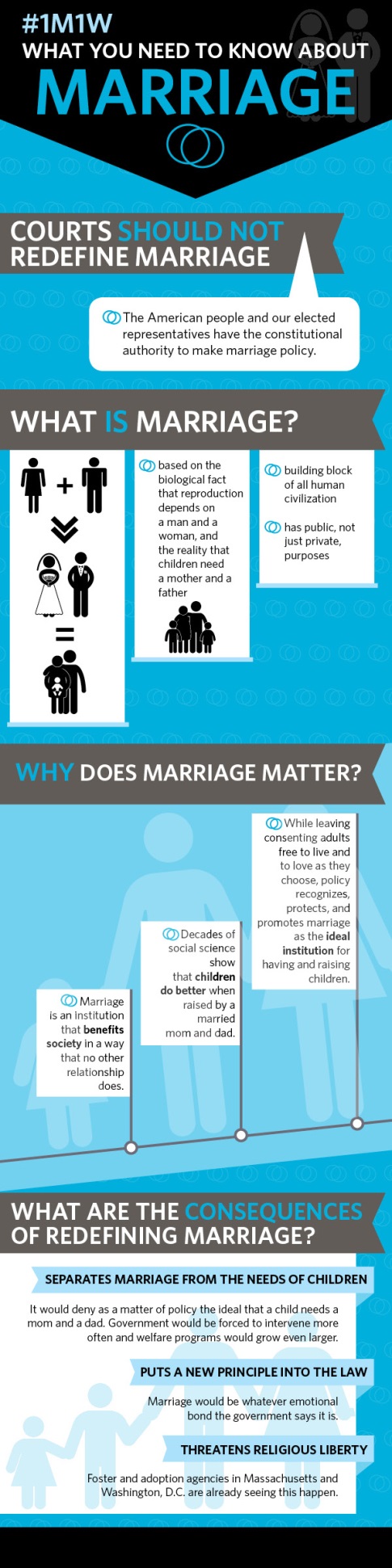
3. As Supreme Court Justice Samuel Alito pointed out two years ago, there are two different visions of what marriage is on offer. One view of marriage sees it as primarily about consenting adult romance and care-giving. Another view of marriage sees it as a union of man and woman—husband and wife—so that children would have moms and dads.
Our Constitution is silent on which of these visions is correct, so We the People have constitutional authority to make marriage policy.
The debate over whether to redefine marriage to include same-sex relationships is unlike the debate over interracial marriage. Race has absolutely nothing to do with marriage, and there were no reasonable arguments ever suggesting it did.
Laws that banned interracial marriage were unconstitutional and the Court was right to strike them down. But laws that define marriage as the union of a man and woman are constitutional, and the Court shouldn’t strike them down.
4. The only way the Court could strike down state laws that define marriage as the union of husband and wife is to adopt a view of marriage that sees it as an essentially genderless institution based primarily on the emotional needs of adults and then declare that the Constitution requires that the states (re)define marriage in such a way.
Equal protection alone is not enough. To strike down marriage laws, the Court would need to say that the vision of marriage that our law has long applied equally is just wrong: that the Constitution requires a different vision entirely.
But the Constitution does not require a new vision of marriage.
Advocates for the judicial redefinition of marriage cannot reasonably appeal to the authority of Windsor, to the text or original meaning of the Fourteenth Amendment, to the fundamental rights protected by the Due Process Clause, or to Loving v. Virginia. So, too, one cannot properly appeal to the Equal Protection Clause or to animus or Lawrence v. Texas.
Nor can one say that gays and lesbians are politically powerless, so one cannot claim they are a suspect class. Nor can one say that male–female marriage laws lack a rational basis or that they do not serve a compelling state interest in a narrowly tailored way, as explained in Heritage Foundation legal memorandum “Memo to Supreme Court: State Marriage Laws Are Constitutional.”
Read this article at: http://dailysignal.com/2015/04/21/what-you-need-to-know-about-gay-marriage-and-the-supreme-court/
